
Oh my goodness me, how we’ve missed it!
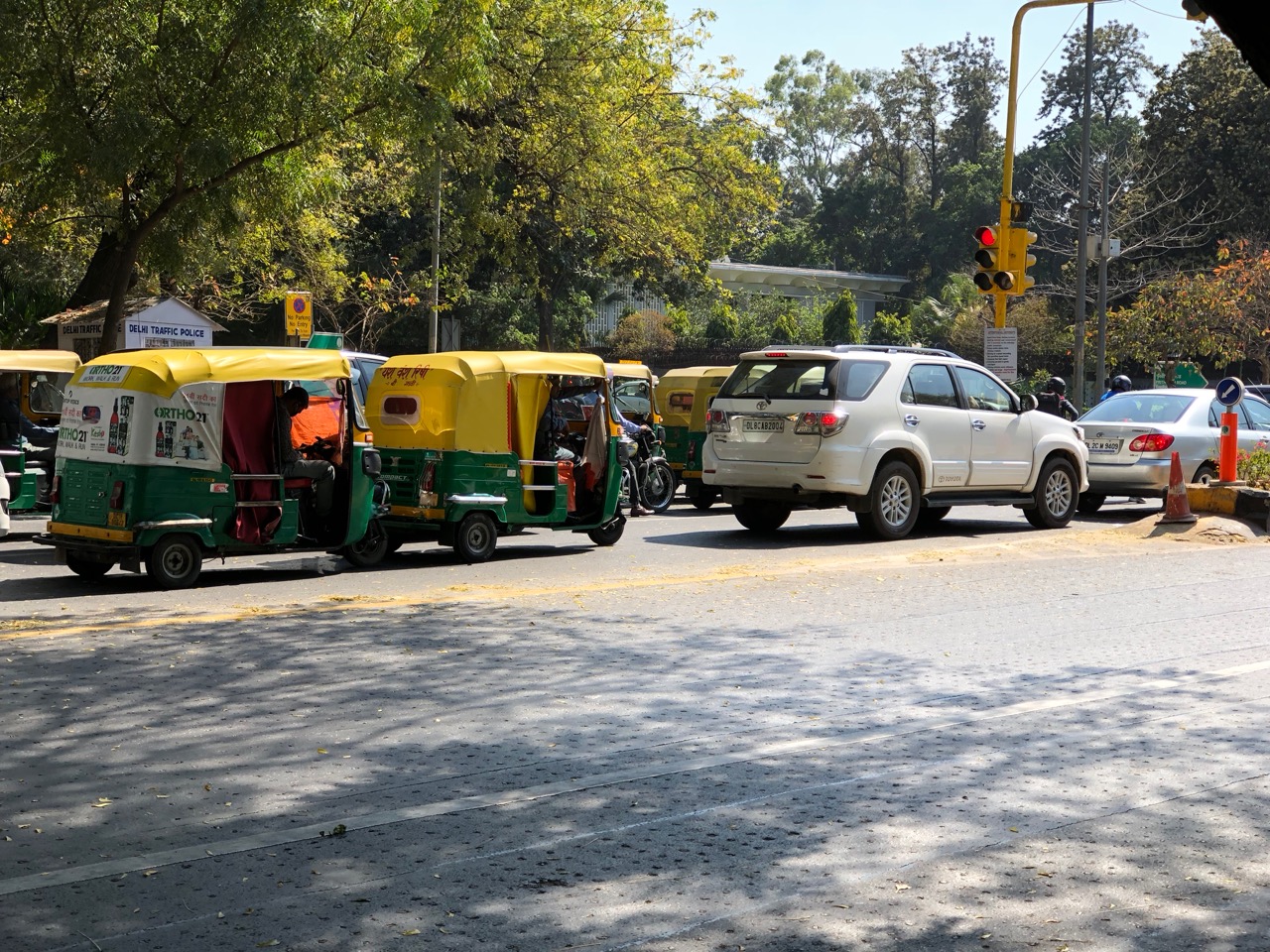
No-one can describe the chaos that is traffic in India but, for some reason, it works … it just does!
Oh my goodness me, how we have missed India! Neither of us realised how much. Let me begin somewhere close to where we left off. Yesterday afternoon Captain Clarke and I went off on a little sortie to Khan Market. This, in itself turned into a bit of an adventure as a) despite very clear directions on how to walk there from our hotel concierge, we managed to get a bit lost finding it, b) when we got there it turned out not to be a market, but a kind of complex of independent shops, bazaars and street food traders, and c) our primary reason for going there was to get some cash from an ATM. Despite being told that there would be several ATMs there, it transpired that there was only one and that this charged me 250 Rupees just for the pleasure of using it! Captain Clarke and I decided that, as we were there, we may as well cover the whole market which we did but, as markets go, it really wasn’t quite what we had expected. It did give us a change though to walk around the streets and see the flora and fauna which is abundant on the sides of the roads. Inevitably there are marigolds and nasturtiums growing wild along the roadsides but there are other aromatics that were deliberately planted and/or have naturalised there since the city of New Delhi was designed by Edwin Lutyens in 1911. We will return to this later.
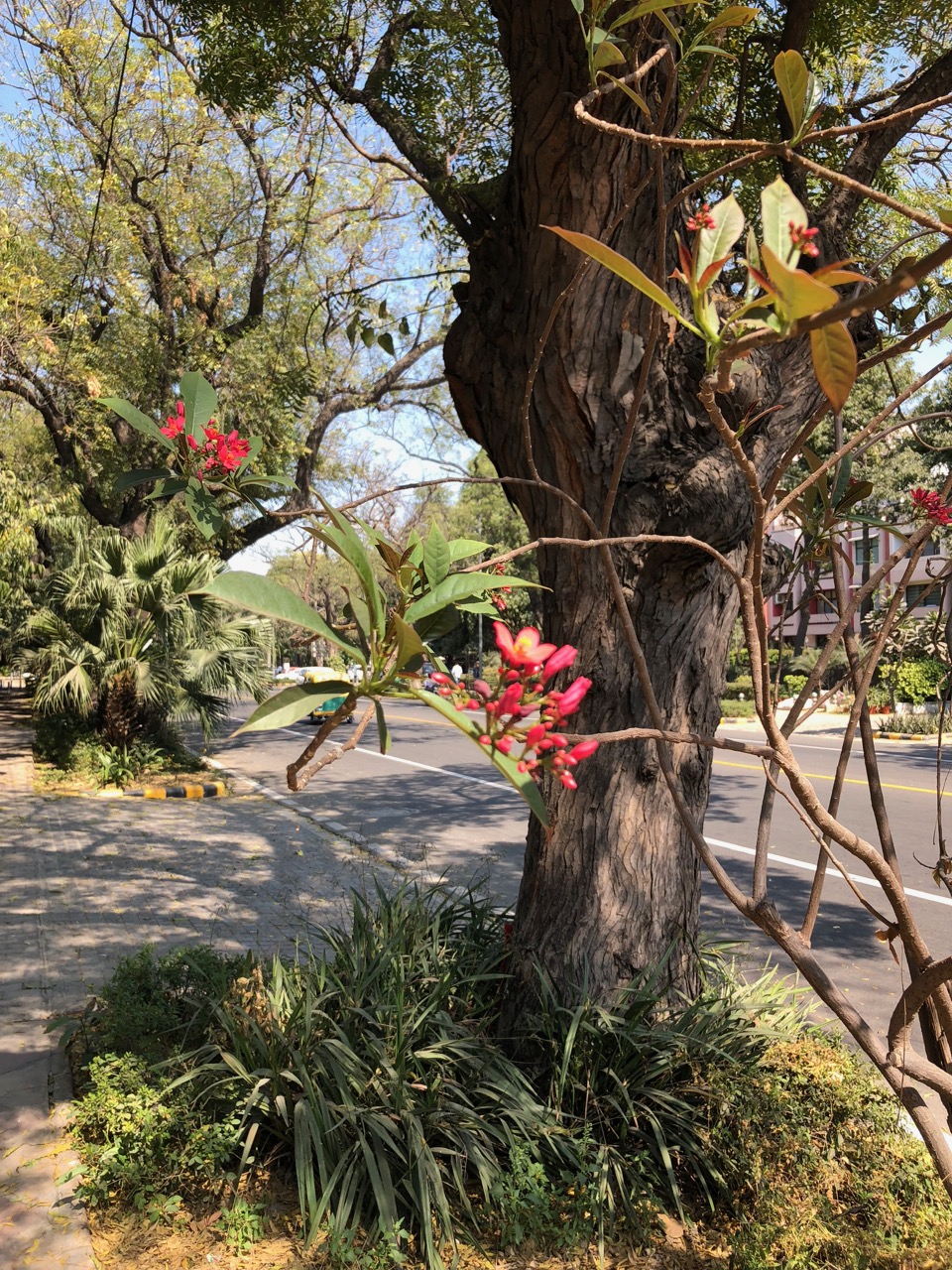
The road side is very lush and green thanks, again, to Edwin Lutyens.
Having obtain a small amount of cash we returned to our lodgings (which I spelt incorrectly yesterday and is call ‘The Claridges’ with one ‘r’) via an equally circuitous route. Nowhere other than in India would you be walking along and suddenly spot a bearded man sitting in the undergrowth completely stoned and smoking pot, next to a lady selling religious artefacts and a chap selling hub caps for cars! When we returned to our hotel, we sat in the gardens and enjoyed a small libation – me a small glass of wine and Captain Clarke a local beer. We decided to study our itinerary as we were meeting the rep from Western and Orient who are organising our tour within India later in the afternoon. We wanted to determine if there were any of the ‘optional extras’ that we wanted to include or any of the included visits (you can get a bit ‘templed out’) that we wanted to exclude. In the end we decided that we were very happy with what we had. There was one optional extra that we thought might be quite fun and that was a trip to a market called ‘Dilli Haat’. Having looked at where it is, we decided that it was so close to the hotel that we could go there without needed to pay for it as an optional extra. Being a bit ‘seasoned’ with travelling around in the world we decided that there was only one way to get there … Tuk Tuk! Now, for those that haven’t ever had the pleasure (and it really is a pleasure), a Tuk Tuk is a little three wheeled vehicle that is usually driven by a complete madman with no road sense what-so-ever and who seems intent in killing himself and you with his ‘ace’ traffic moves!
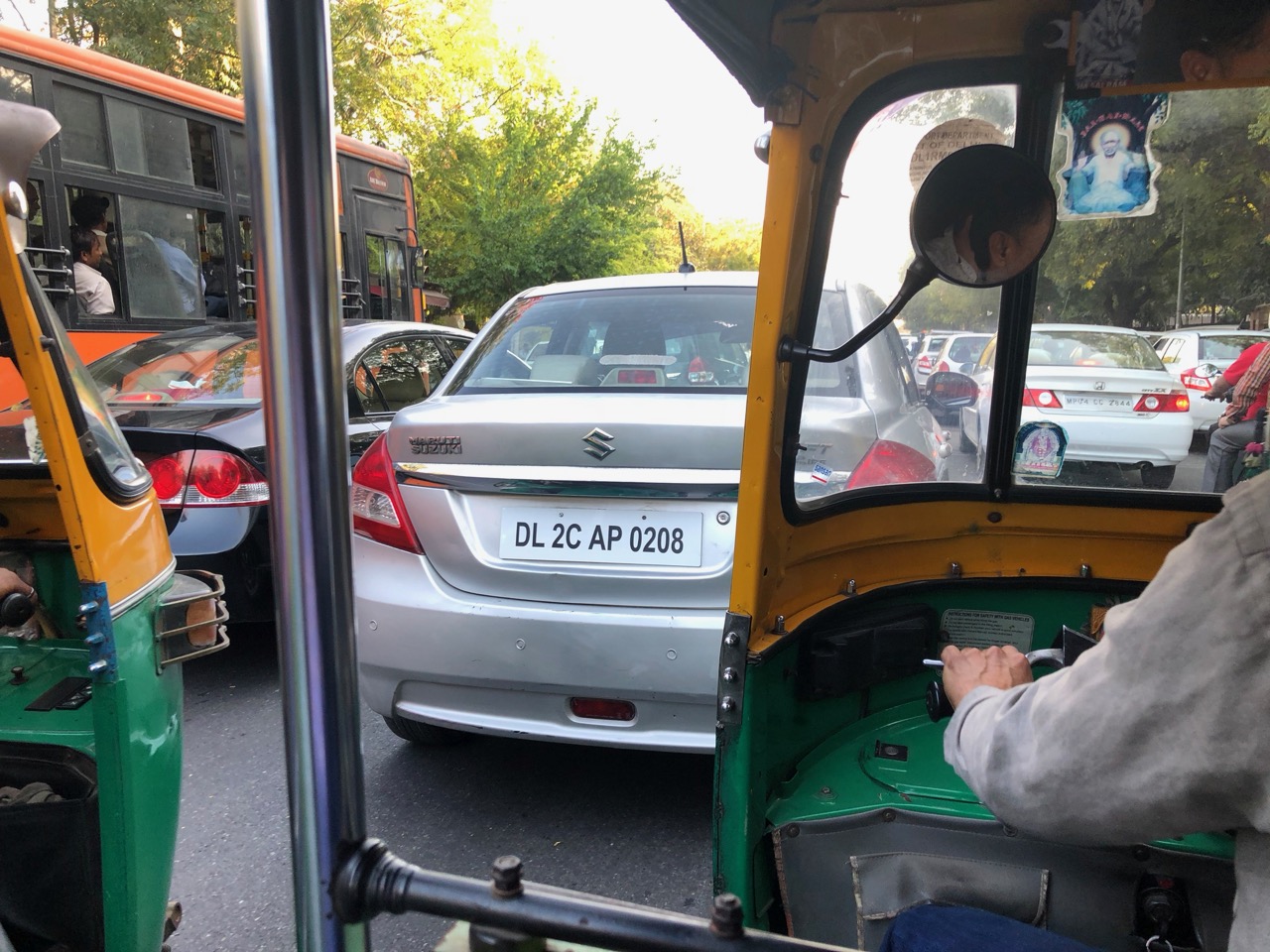
Hurtling between the cars, motorbikes, buses and anything else on the road, we overtook pretty much all this lot!
This one did not disappoint! He only had one speed – flat out – and he really didn’t bother too much with brakes. He weaved and wove his way through the traffic, pulling straight out in front of cars, motorbikes, cars, buses, lorries and anything else that got in his way (or even dared to). His hand gestures and use of horn were expertly executed and, although we never quite made it to Dilli Haat, we did make it to his ‘friends’ shop where they sold “the best garments, carpets, jewellery, carvings and souvenirs anywhere in India!”. Those seasoned Tuk Tuk users will understand exactly what kind of shop this is! We did NOT buy anything. When we came out, he seemed a bit surprised that we had resisted the temptation to purchase. He was amazed we hadn’t found anything we wanted to buy and asked why not. We explained that if, and it was only if, we were interested in anything it would have been a wooden spice box and that his ‘friends’ shop didn’t sell them. This was mistake number two – “Why didn’t you say?”, he said. Within a few seconds we were hurtling off in the direction of his ‘cousin’s’ spice shop (he may not have actually said it was his cousin, but you get the general gist).
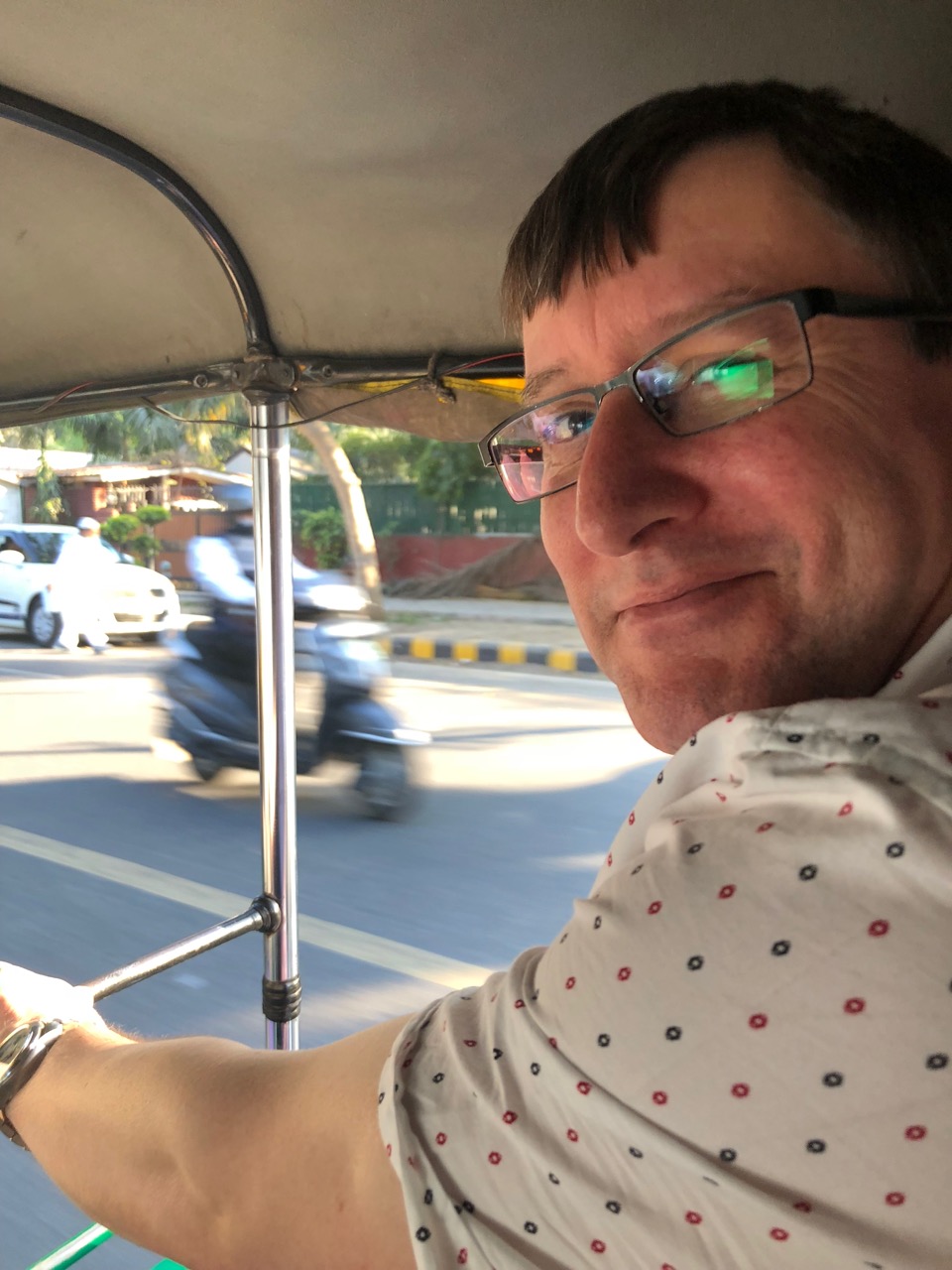
Captain Clarke holding on for dear life … or was that grimacing just wind!
Arriving at his ‘cousin’s’ shop we discovered that no, they didn’t sell the either. “No matter”, said our ever helpful Tuk Tuk driver, “my brother’s shop is next door but one, he’ll sell them!”. It may not have actually been his brother’s shop, but they did indeed have just one wooden spice box. After a certain amount of negotiation and much sucking of teeth, a price was finally agreed and we procured said box. Since we had the rep from W&O coming to the hotel at 18:30 we had run out of time to visit Dilli Haat, so we needed to return to our hotel. We hurtled and lurched our way back to the hotel and actually made it in excellent time, arriving a good 15 minutes earlier than could ever have been predicted. I should mention, at this point, the price. When we first engaged with our Formula 1 trained Tuk Tuk driver, he had asked for 100 Rupees (£1) to take us to Dilli Haat. I had explained to him in the nicest possible way that he was having a laugh and that I certainly wouldn’t be paying anything of the sort! We settled on 50 Rupees. Now, having returned to the hotel, and having had sole use of his services for around 2 hours, we had to agree a price again. He seemed a bit embarrassed and asked for 200 Rupees but said that, if we weren’t happy with that we could pay him what we wanted or even nothing at all. To be truthful we had spent almost 2 hours having the greatest fun, laughing (sometimes nervously!) at his antics in the traffic, taking the Mickey remorselessly for his never ending supply of family run shops, and generally having a good time. I didn’t have 200 Rupees on me (the ATM had only given bigger notes) so I gave him a 500 Rupee note which, if I’m honest, was damned good value for money for the fun we had had! He was delighted and was thanking him like we had given him £1 million not a fiver, so all in all we were all happy. India is such a delight. We had a fantastic time with a complete stranger and, although we never got to Dilli Haat, we went to some places that most tourists definitely wouldn’t get to see!

A ‘Bramble’ cocktail and a Pineapple, Cardamom Martini – very nice indeed!
Yesterday evening, after a freshen up (remember that by this time we have been going around 36 hours with only 2 hours sleep) we decided that we needed a bit of a pick-me-up. We went to the hotel bar where, if I am to be totally honest, I was looking forward to a glass of ‘Black Dog’ – a whiskey that is distilled in Scotland but only sold in India at a fraction of the cost of an imported whiskey (if that makes any sense, which it doesn’t!). Our hotel bar doesn’t sell Black Dog, so we decided on a cocktail instead. Captain Clarke had a ‘Bramble’ cocktail which was basically gin, with blackberry syrup, ginger ale, lemon and crushed ice – he rather enjoyed this, I fear, as it was gone in a matter of minutes! I had a Pineapple, Cardamom Martini – vodka, pineapple juice, fresh cardamom (only available here in India) and soda water – it was blinkin’ lovely and definitely oriental. That said, we both decided that they were ‘one cocktail drinks’ and decided that, for our second drink, we would revert to a good old ‘scotch on the rocks’!
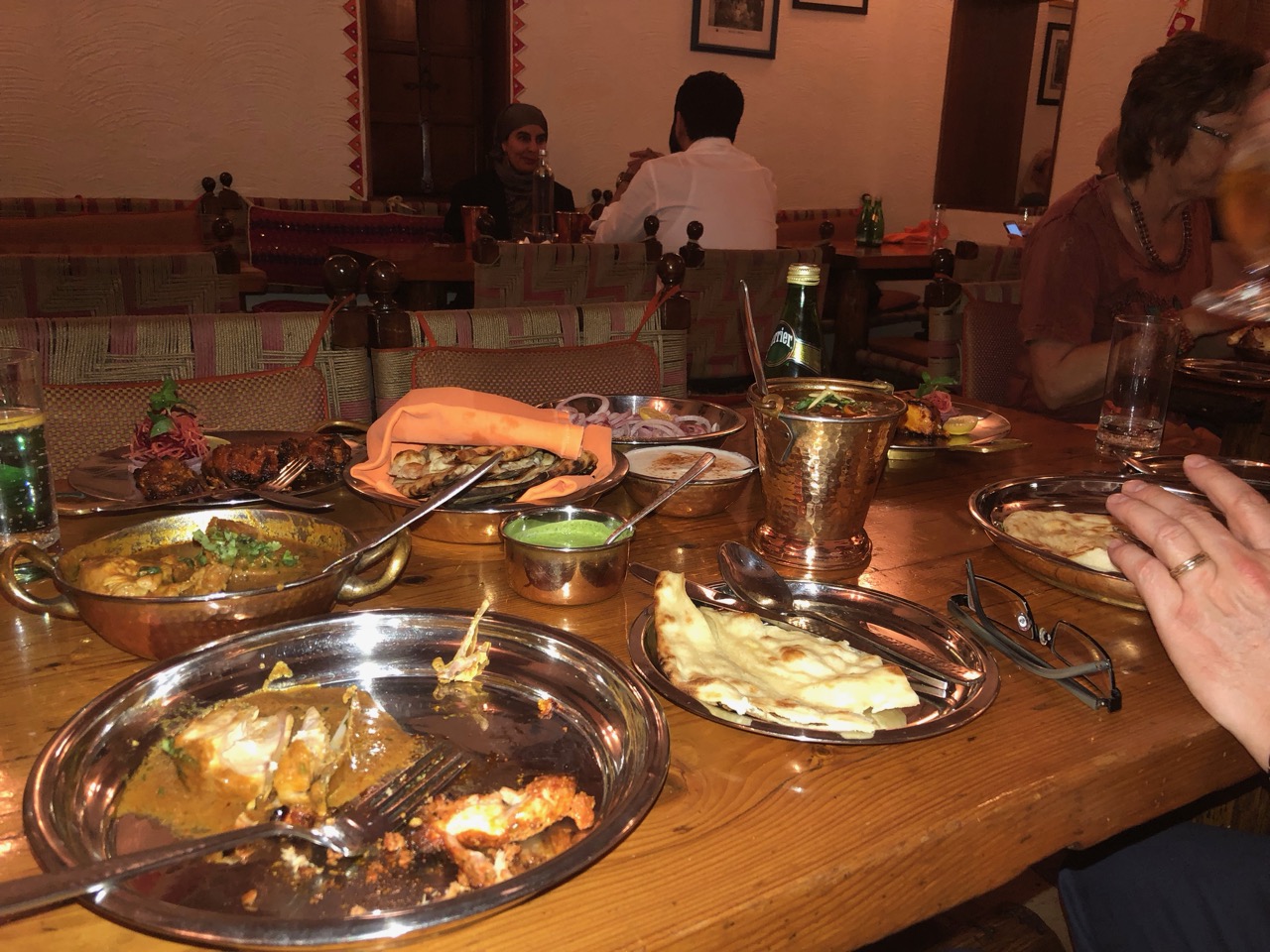
The food in the Daghe restaurant was absolutely superb – nothing like we have ever tasted before, but superb!
We had booked a table in one of the hotel’s four restaurants called Dhaba which serves authentic North Indian street food but in a restaurant environment. Oh boy, was that food good! Captain Clarke had a fish tikka to start, followed by a lamb shank in a rich and spicy sauce. He wasn’t desperately enamoured with the lamb shank but the fish was delicious. I had ‘Street Style Chicken Tikka’ to start which was not a bit like chicken tikka that we get at home but was absolutely superb and I followed that with ‘Chicken Curry’ which was, apparently, an authentic curry that is served as street food with naan bread. Again, it was nothing like any chicken curry I have ever had or made, but the flavour was stunning and the only problem I had was that I ate far too much and regretted it later! Our guide today recommended that we try this restaurant (not realising that we did last night) and recommended the ‘Mutton Rogan Josh’ which she assured us is not lamb but goat. She, like me, cannot bear lamb in curries but she loves goat. Captain Clarke asked specifically yesterday evening if it was lamb or goat and the waiter assured him that it was lamb. Our guide swore on a stack of bibles today that no self-respecting India would ever serve a Rogan Josh with lamb and that the Rogan Josh in our hotel restaurant is definitely goat. She said the waiter was only saying it was lamb because if he said goat we probably wouldn’t order it, just like most English people. We assured her that we are the opposite and we tried to book a table when we got back today but we can’t get in, so we will never know!
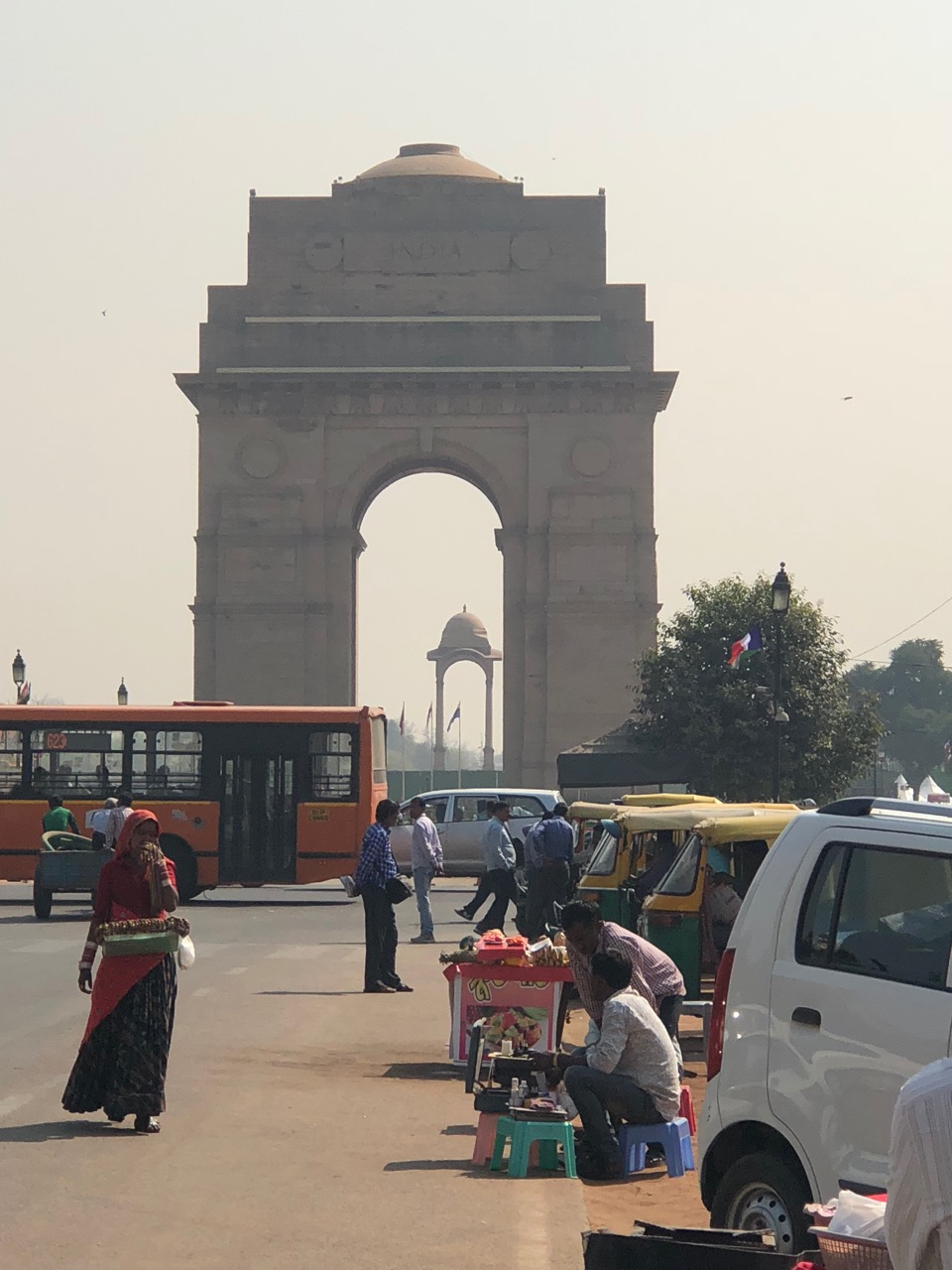
The India Gate commemorates those who lost their lives fighting in the First World War.
This morning we rose relatively early to start our sight seeing around Delhi. Delhi is essentially in two parts – Old Delhi is a walled city and dates back thousands of years to around the 4th century and New Delhi was created by the British when King George V decided that he wanted the capital of India to be Delhi (it had previously been Calcutta … now known as Kolkata). He wanted Delhi to be the capital of India and proclaimed that it would be in 1911. The only problem was that Old Delhi (then just Delhi) did not have enough space to support the Colonial rule, so he decided to build a new city to be called ‘New Delhi’. Since he didn’t have the resources here in India to do such a thing (or probably didn’t trust that he had the resources) he decided to bring in none other than renowned architect Edwin Lutyens to design it. Lutyens was here in Delhi from 1911 until 1931 and he designed New Delhi around a series of ‘boulevards’ with the principal one being Rajpath which connects the parliament buildings with the India Gate. The India Gate is, or course, the monument that Lutyens is well known to have designed to honour those who lost their lives in the First World War. The Rajpath is very much modelled on the Champs Élysées in Paris with the parliament buildings at one end (similar to the Place de la Concorde at one end and the Arc de Triomphe at the other) represented by the India Gate. Instead of there being shops and bars all down the sides of the boulevard, here in Delhi there is greenery and grass.
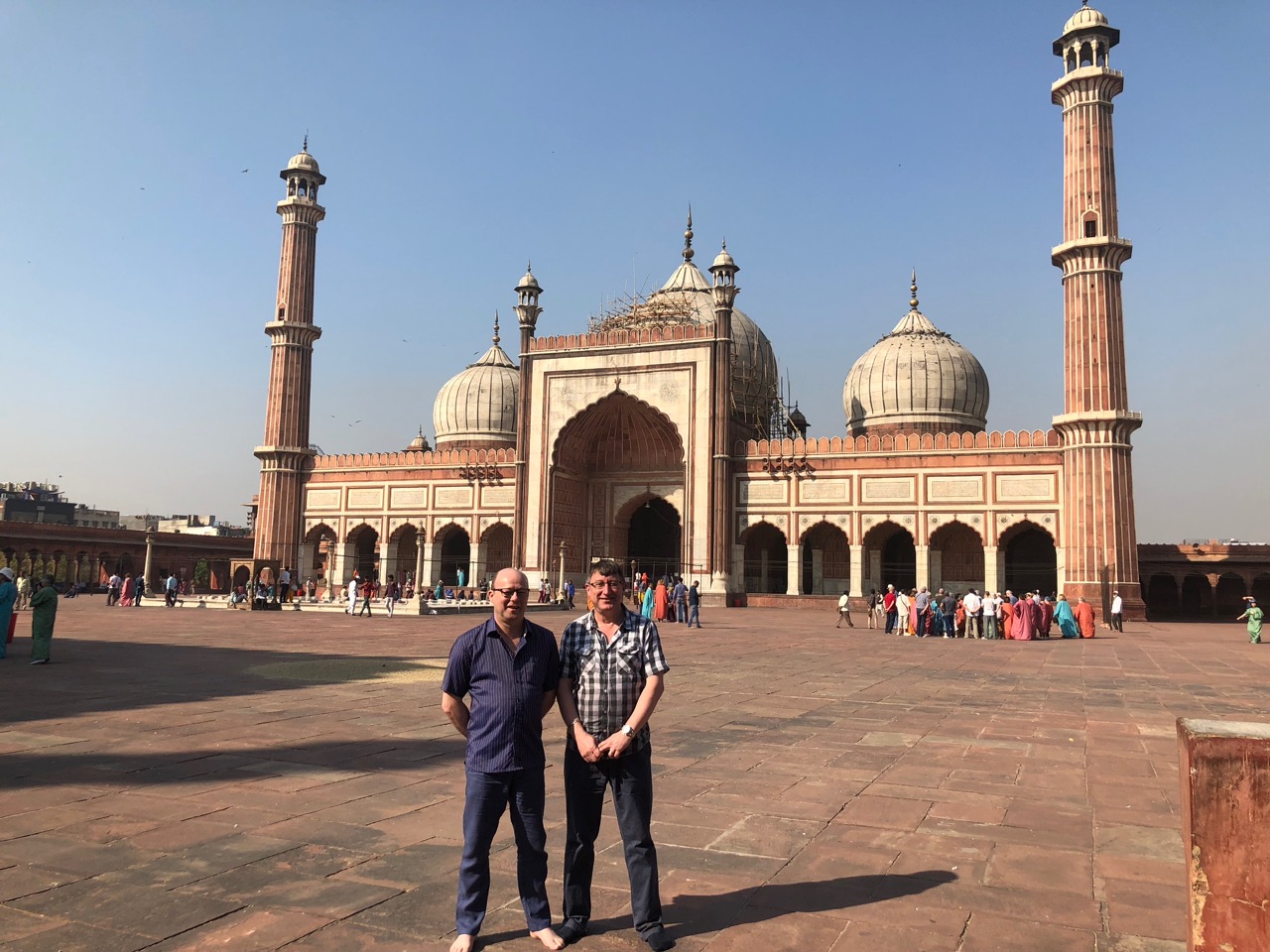
Captain Clarke and myself in the courtyard of the Jama Masjid mosque – the largest mosque in India.
We did not, in fact, start this morning’s sight seeing with New Delhi, but our tour began in Old Delhi. Our guide, Zareen, was superb because, not only does she do guiding for W&O but she is also a part time historian lecturer at one of Delhi’s universities. We began by visiting the Jama Masjid which is the largest and best known mosque in India. It has a capacity of 25,000 for prayer. The mosque was commissioned by the Mughal Emperor Shah Jahan, builder of the Taj Mahal. The mosque itself is constructed of red sandstone from Delhi, smooth white marble and slate inlays which are used on the walls of the mosque to spell out passages from the Koran. It is still very much in use today and we had to be out before 11am because prayers would be called and non-muslims are not allowed to be inside when this happens and, more importantly, women are not allowed inside the mosque, so our guide Zareen would have been unceremoniously ejected. She is allowed into the mosque as an official tour guide but must be out before prayers begin. Apparently on Fridays the mosque still attracts crowds of 20-25,000 people!
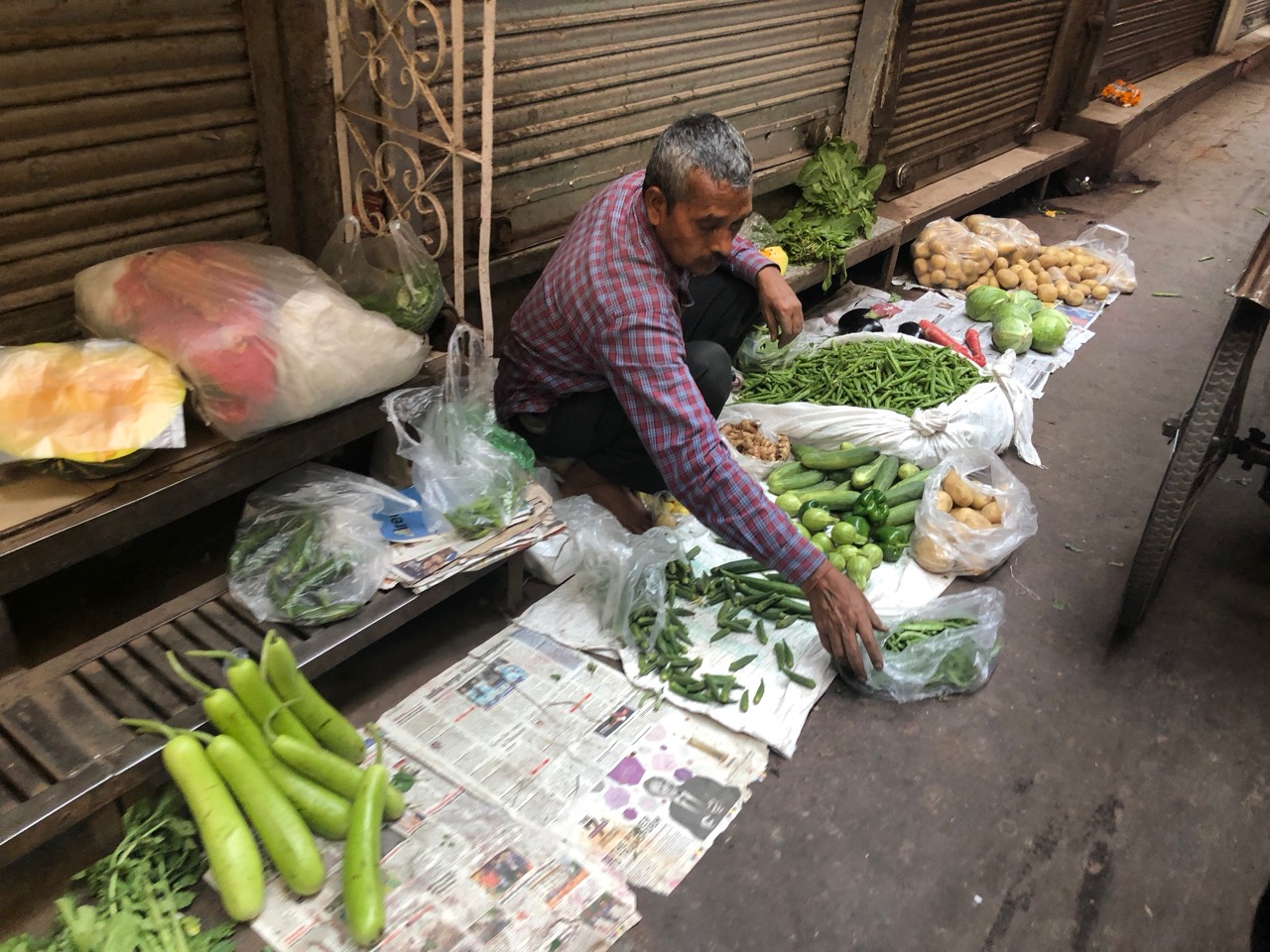
From a cycle rickshaw ride around Chandni Chowk, one of the oldest and busiest markets in Old Delhi.
Our next stop was a cycle rickshaw ride around the streets of Chandni Chowk which literally means ‘Moon lit square’. It is one of the oldest and busiest markets in Old Delhi. It is called Chandni Chowk because there used to be a small stream running through it and, on a moonlit night (full moon), it can be seen from the Red Fort. The Red Fort, according to our guide, has somewhat fallen into disarray since the British stripped it of much of its features to create barracks for troops stationed in Delhi under colonial rule. Having Googled this, it appears that some parts are still open to tourists but the main mosque and public baths are closed due to their poor condition. I get the impression that, whilst she was accurately reporting the actions of the British (and did not do so in any derogatory way) Zareen did not want to go to the Red Fort, so we didn’t go. That said, it is not on our itinerary, so I guess W&O also see no value in visiting it. The one slightly disappointing thing about our trip around Chandni Chowk was that Zareen advised us that we must not get off the rickshaw at any time, to avoid contact with any people and not to go near any dogs. She implied that to do so would be dangerous. Not that we would necessarily have wanted to get off, but it was a shame she felt it necessary to say this.
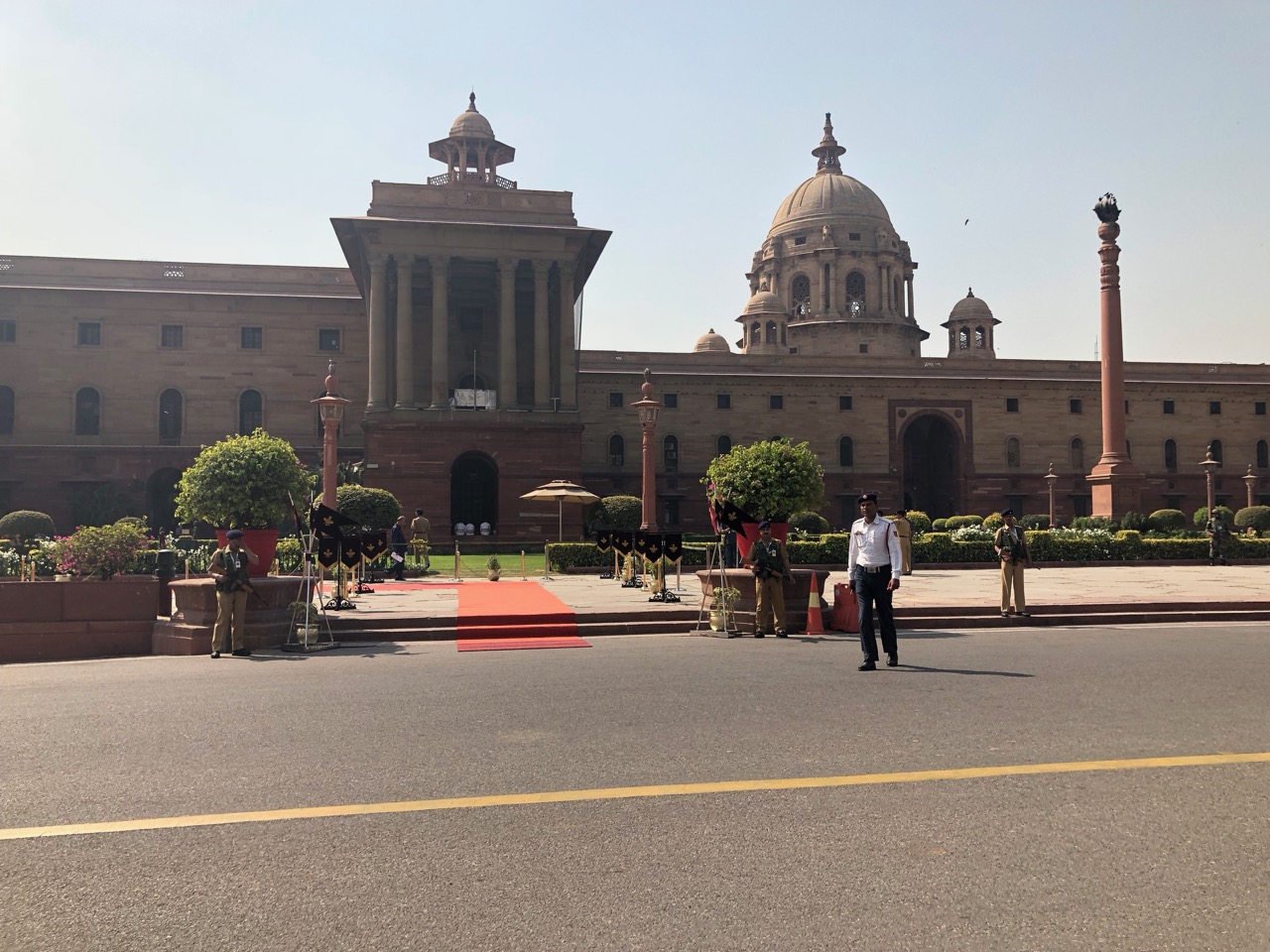
The red carpet wasn’t for us – apparently President Emmanuel Macron of France is arriving on a state visit!
Following our exciting and exhilarating trip around Old Delhi it was back to New Delhi for a closer look at the India Gate and then the Parliament Buildings. These buildings were also designed by Lutyens and there are four similar buildings each with a column (to the right in this picture) which represented another of the British Colonies; Australia, Canada, South Africa and New Zealand. Since independence in 1947, India has not taken any of these monuments to the colonies down but has, instead, put a lotus flower and a signal of Indian independence on top of the original monument. It I actually a very clever way of placing their independence stamp on it! Whist we were there, we saw lots and lots of armed guards along with representative of the Indian Army, Navy and Airforce, a military band and a huge security presence. Apparently the red carpet wasn’t laid out for us and, when Zareen asked one of the soldiers who it was for he said, “Some French bloke”. We had seen the French flags all the way down the Rajpath, so we kind of guessed that much. Returning to the car (which has excellent WiFi) a little Googling revealed that the “French bloke” is actually President Emmanuel Macron of France who is here on a four day State Visit! Apparently, visiting dignitaries are always received at the Parliament Buildings by the Prime Minister who’s residence is adjacent to the parliament buildings (we were not allowed to photograph his residence but it is in the Lutyen style).
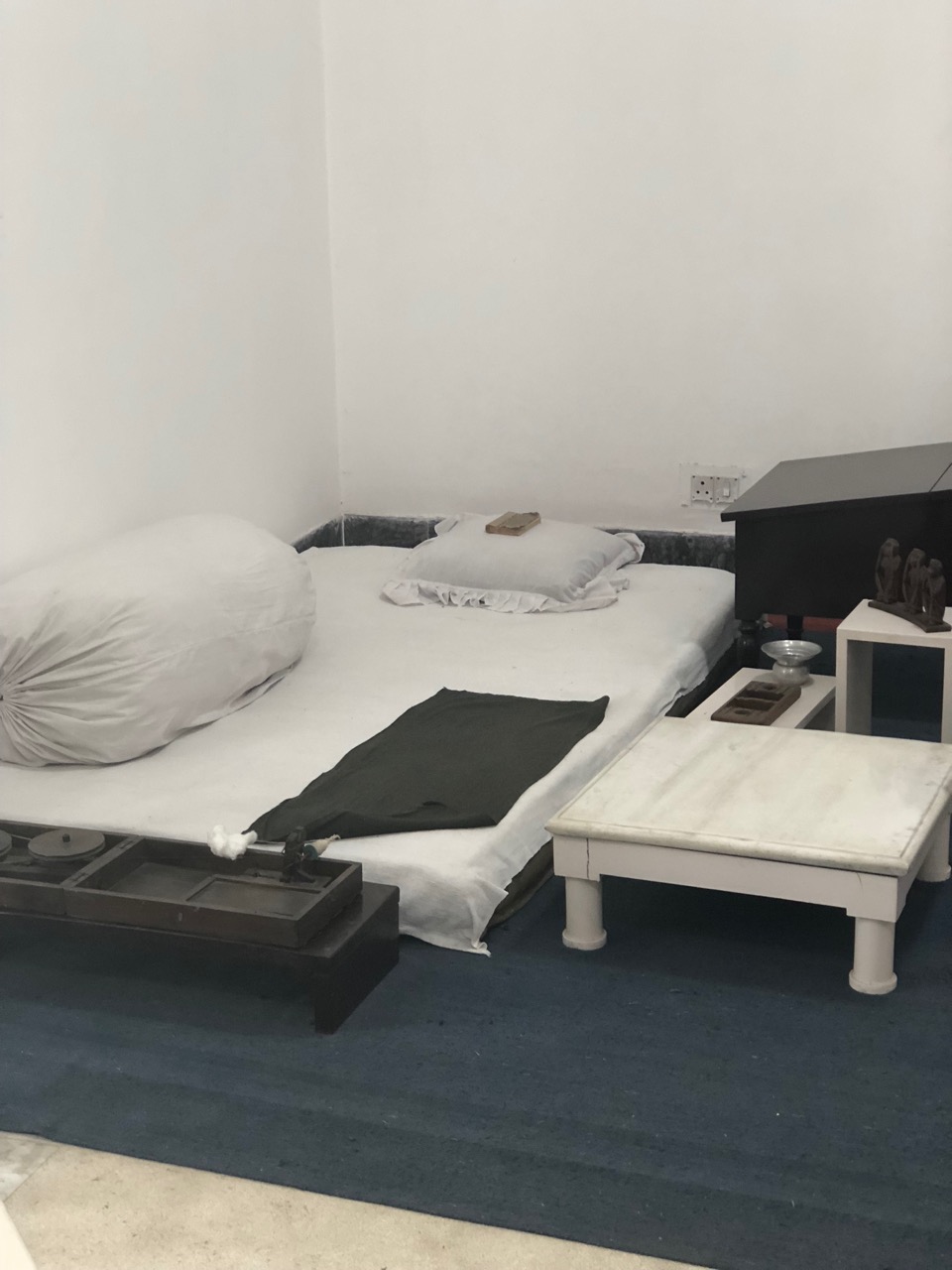
Ghandi’s room at the Birla home where he was living at the time of his death.
Our next stop today was to visit the house where Mahatma Ghandi had a room. Many people call it Ghandi’s house but it was actually owned by the Birla family who were a wealthy Indian family at the time and who owned a large house I which Ghandi had just one room. He lived, slept, prayed and negotiated in this one room as part of the Freedom Movement. Unbeknown to Captain Clarke and myself, Mahatma Ghandi only lived in this room for 144 days whilst he was trying to negotiate to get a fair partition of India. He was ultimately shot three times in the chest by Nathuram Vinayakrao Godse who was a right wing advocate of Hinduism and who believed that Ghandi was favouring the Muslims. Ghandi, who believed in non-violence and peaceful negotiation, did not favour either side. Now known as the ‘Father of India’ Ghandi is credited with the success of the Freedom Movement although, in truth, the Freedom Movement had started in 1857, some 12 years before Ghandi was born, but Ghandi’s involvement in trying to provide solace in areas where partition had left some with religious beliefs of Islam, Hinduism and Sikhs had been left isolated is what many remember him for. Some felt that he had been too accommodating to the newly created muslim country of Pakistan when India was compelled to pay out some assets and cash that it owed to Pakistan following partition. Godse was one of those. It seems that there is a lot here that Brits have nothing to be proud of and there are parallels to be drawn with the right wing nationalism of today! Maybe we should all take two minutes to think about the anti-Islamic, anti-tolerance, right wing state the world is in today (Trump should think more carefully about his wall, the Brits should think more carefully about what Brexit really means and the Russians should think carefully about nerve agents) and remember what our actions did in the past! Just saying …
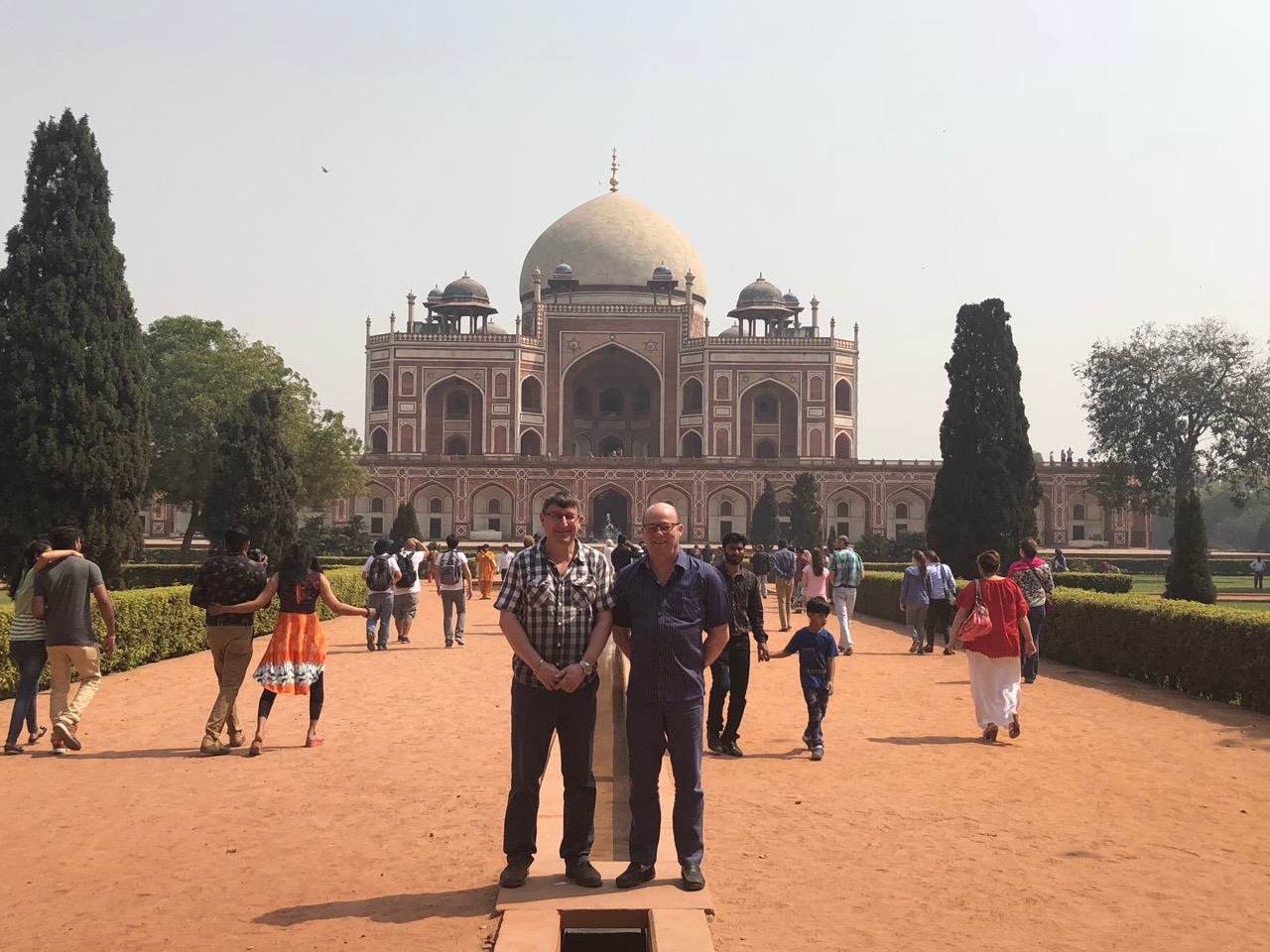
Captain Clarke and myself in front of the Humayun Tomb.
Onwards with our tour we next visited Humayun’s Tomb. This is another building steeped in history. Built for Emperor Humayun, another Islamic Emperor of India, the tomb houses the emperor himself and 120 other royals from the period. In the Koran it is written that muslims must be buried in simple graves that are not adorned with riches in a place that represents paradise. Clearly, this didn’t fit with the opulence and demonstrations of wealth that the Emperors were so famous for, so they came up with this idea. The Emperor is buried in a simple grave that is just earth over his body underneath the tomb in a chamber (there are numerous doors underneath the tomb, all of which lead to the burial place of one or other of the royals and ultimately the burial place of the Emperor) but the tomb was constructed over the burial place and has opulent marble tombs, a grand building and terraces to view from and 16 gardens all connected with perfumed rills that run between them. This, he claimed, was the representation of paradise but his burial place was simple … the best of both worlds, me thinks! According to Zareen, this is the building upon which the Taj Mahal was modelled and, to her, is the more important having been completed more than 80 years before the Taj Mahal. We have yet to see!
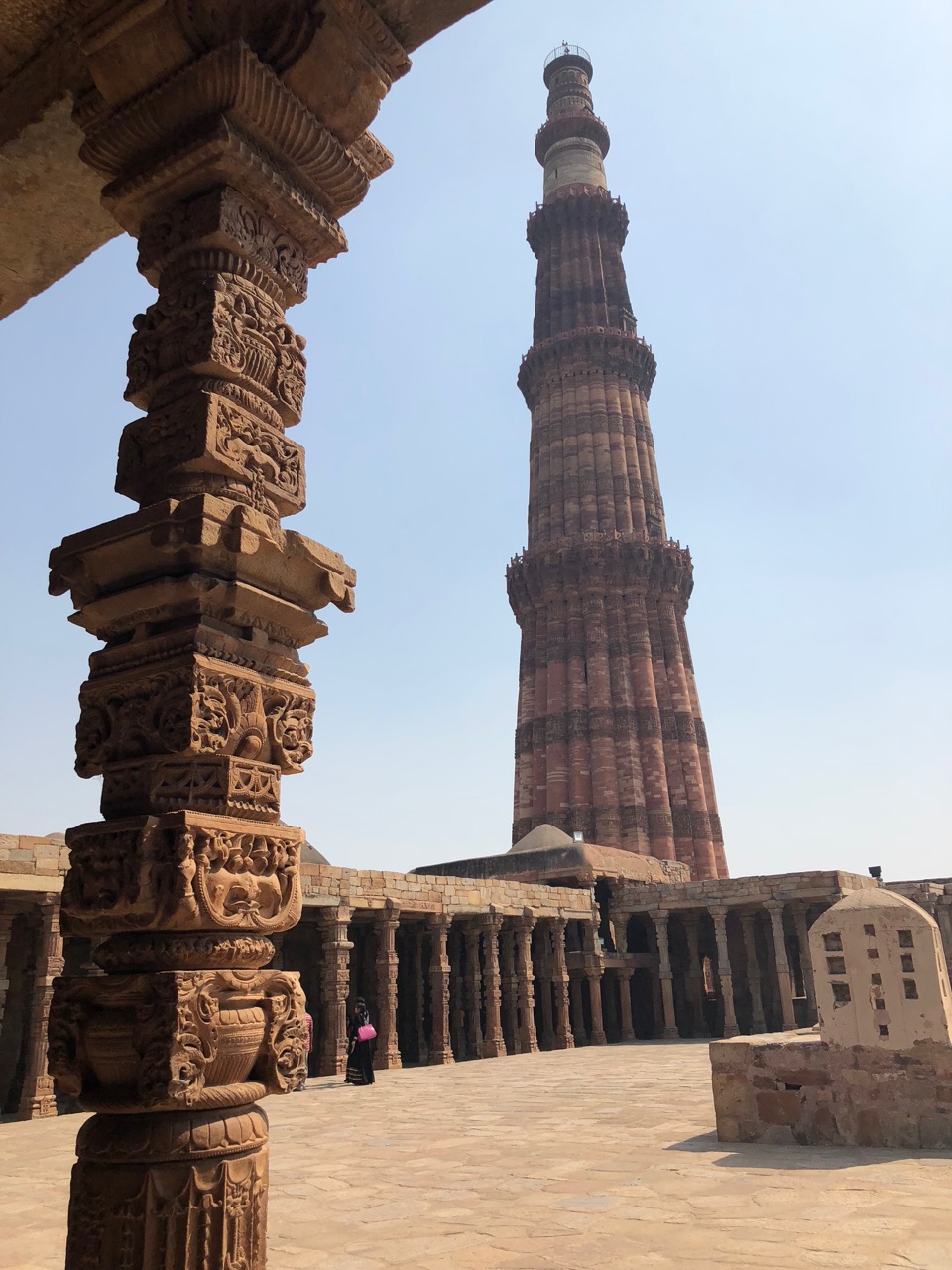
The Qutb Minar – at 72.5 metres tall, it is the tallest stone tower in the world. Imagine knocking that up in the 12th century!
Our final visit of the day was to the Qutb Minar which is the tallest stone tower in the world. The Minar is an incredibly interesting construction on a site called the Qutb Complex that once housed 17 Hindu temples. Then, along came the muslims from Persia, took over rule and knocked the Hindu temples down, turning what was left into Islamic mosques. The Minar was then constructed by Qutb-ud-Din Aibak and completed by his successor Iltutmish (blimey, these names are difficult to spell, I keep having to note them down on my phone!). Although the Islamists were in rule at this point in time, the facade of the Minar is not entirely islamic. This is because of the fact that Hindu labour was used to build it. Hindo-islamic building (as it is known) is present all over Delhi because the Islamic designs were produced by the rulers, but the rest of the construction was left to the Hindus. Where they felt additional decoration was needed, the Hindus would add it but, not because they wanted to make any particular statement, the only decorative style that they knew was a Hindu style, so that is what they did. The decorative facade is primarily in an Islamic style but is interspersed with Hindu decoration where the construction workers felt additional decoration was needed. This was a spectacular end to our day (almost) of sight seeing in Delhi and we thoroughly enjoyed it. Our guide, Zareen, was incredibly informative, balanced in what she said, and friendly too. In fact, we have swapped email addresses so that we can swap some European cooking recipes with some authentic Indian ones that she cooks with her mother!

An Indian squirrel
Just before we left the Qutb Complex there was one final thing to see. This was not the first time we had seen these little animals – we saw them quite a bit on our first visit to India in Kovalam and we were intrigued as to what they were. Captain Clarke and I discussed yesterday how they looked a little like chipmunks, although, since they are native to North America, we didn’t think they were chipmunks. Having managed to obtain this photo, I thought it only pertinent to ask Zareen what they are called. She looked at me rather surprised and said, “Squirrels!” Slightly embarrassed at what appeared to be the stupidity of my question, I mumbled that squirrels in England are either grey or red, we don’t have striped squirrels. “Ah”, she said with a wink, “then maybe there is something that you British left behind when you left after all!”. Touché, I think! Said in jest and taken that way, it was a good note to end our day! We retired to the lawn of the hotel for gin and tonic (two in Captain Clarke’s case!), a light lunch of Indian snacks and then, a lay down for him and me to write today’s missive. Tomorrow we are off to Jaipur where the adventure continues. This, I think, will be my only 4,000 word essay but I know that if I don’t write it down, I will never remember afterwards! And, since I have taken about a million photos already, I am resorting to photo galleries – below you will see a photo gallery for each part of our day which will make it easier for you to peruse, or not, our holiday snaps! It is, as they say, RudyMenTerry!


Interesting – I am intrigued as to how similar you style of writing is to that of Monty 🙂
We share the same master!